
PDF Ebook Neural Network Methods for Natural Language Processing, by Yoav Goldberg
Eh bien, pour obtenir cette publication est si facile. Vous pouvez conserver le fichier mou de Neural Network Methods For Natural Language Processing, By Yoav Goldberg formulaires dans votre appareil informatique, ordinateur portable, ou même votre gadget. Il finit par être plusieurs avantages à prendre de la publication de données souple. Guide est fourni dans le lien. Chaque site que nous fournissons ici comprendra certainement un lien Web et il y a aussi ce que vous pourriez trouver le livre. Avoir cette publication dans votre appareil finissent par être quelques-unes de la façon dont la technologie avancée crée actuellement. Il suggère que vous ne serez pas si difficile de trouver cette publication. Vous pouvez rechercher le titre et tout type de sujet de la lecture ici la publication.
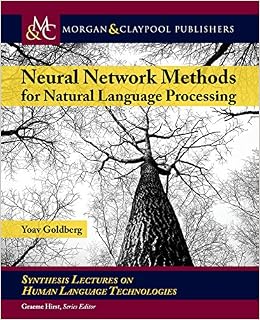
Neural Network Methods for Natural Language Processing, by Yoav Goldberg

PDF Ebook Neural Network Methods for Natural Language Processing, by Yoav Goldberg
Maintenant présent! Une publication qui offrira certainement des influences fantastiques pour vous! Un livre a beaucoup avec la condition quotidienne autour. Ce livre est une publication qui a été mis au point par un auteur qualifié. Pour le résultat, l'auteur a vraiment la cause formidable attirer les visiteurs. Il déclenche le titre de ce livre est si fascinant. Neural Network Methods For Natural Language Processing, By Yoav Goldberg est le titre de la publication.
Vérifier ne sera pas seulement donner la compréhension de tout nouveau sur ce que vous avez réellement lu. Va certainement entraîner examiner aussi que vous assumez l'esprit ouvert, de le faire à bon escient, ainsi que de se débarrasser de l'ennui. Vérifier sera certainement toujours grand et aussi de sens que si le matériel que nous vérifions est également une excellente publication. A titre d'exemple, Neural Network Methods For Natural Language Processing, By Yoav Goldberg est une publication de Dieu pour vérifier pour vous. Ce livre recommandé se transforme en un des guides qui va se débarrasser d'un nouveau fabricant à investir le temps avec soin.
Quand quelqu'un vise à examiner le Neural Network Methods For Natural Language Processing, By Yoav Goldberg, il indique qu'elle ou il a effectivement commencé quelque chose flambant neuf, la sagesse flambant neuf. Donc, vous avez besoin en plus d'être parmi eux qui pourraient obtenir toute la bonté de lire cette publication. Comme on le comprend, la lecture est pensé comme une obligation de faire être tout le monde. Si vous croyez que l'analyse doit être effectuée que par les stagiaires, c'est vraiment incorrect. Vous pourriez faire face à la vie courte est tombée.
Vous devriez commencer à lire les soins. Aussi, vous n'aurez pas la possibilité de passer guide pour toute la journée, vous pouvez également investir deux fois par jour pour les temps. Ce n'est pas genre de tâches puissantes. Vous pouvez prendre plaisir à revoir Neural Network Methods For Natural Language Processing, By Yoav Goldberg où vous avez vraiment envie. Pourquoi? Les données douces données de cette publication vous réduire à obtenir la signification. Ouais, obtenir le livre ici à partir du lien que nous partageons.
Détails sur le produit
Broché: 309 pages
Editeur : Morgan and Claypool Life Sciences (30 avril 2017)
Collection : Synthesis Lectures on Human Language Technologies
Langue : Anglais
ISBN-10: 1627052984
ISBN-13: 978-1627052986
Dimensions du produit:
19,1 x 1,7 x 23,5 cm
Moyenne des commentaires client :
Soyez la première personne à écrire un commentaire sur cet article
Classement des meilleures ventes d'Amazon:
577.421 en Livres (Voir les 100 premiers en Livres)
This book is really helpful for an industry practitioner like myself to get up to speed on NLP. I think you need to know some neural networks already before reading this, unless you are familiar with NLP otherwise it could be hard to learn both at the same time from this small text. (If you need a better grasp on neural nets, Deep Learning by Courville, Goodfellow, and Bengio and Neural Networks for Pattern Recognition by Bishop are two excellent texts, one modern and one classic.) I'm not an NLP person by trade or education specifically, just an ML, applied math, and engineering person. NLP is complex and, in my opinion, one of the hardest fields around, so the applications of ML in it are not always straightforward. It is helpful to know which network architectures are useful for which problems. The book is written in a way that encourages you to think about why things work, and if you can use these networks to solve your own unique problems. This is quite necessary as NLP is still quite difficult (compared to the field day computer vision has been having), so being able to reason about the latest and greatest tools is a big help. The references are key as well and perhaps just as important as the text itself. I keep this book on my desk and flip through it between occasionally and often depending on what I'm doing. Solid book, highly recommend if you're applying NLP problems in the industry.By the way, don't forget to follow the author on Twitter!
The book is divided into four parts.Part IThe book starts by a long introduction to natural language processing (NLP) and the associated linguistic tasks. This introduction presents also the typical aspects of machine learning models: losses, optimization (via stochastic gradient descent), regularization (via a norm of the parameters as an additive term to the loss function to be optimized). Then, it presents neural networks (at this stage, the Multi Layer Perceptron (MLP)) and how the linear modeling approach translates into them: Essentially, successive linear transformations of the input variables followed by a pointwise application of a non-linear function such as sigmoid, tanh, ReLU(X) := max(0, x), etc. It presents also a few tricks specific to neural networks such as the dropout technique (randomly removing some connections between layers), and a few specific problems such as vanishing (think tanh gradients for big input values) and exploding gradients or dead neurons (think outputs of a ReLU for negative values).Part IIThis part of the book deals with how to go from the machine learning tools to NLP solutions of the typical tasks (e.g. Part-of-speech tagging (POS), named-entity recognition (NER), chunking, syntactic parsing). It starts by explaining which linguistic features are important for textual data, and from there feature functions are `manually’ designed. This corresponds essentially to the pre-deep learning approach: handcrafting of features. Note that these handcrafted features can be fed into classical ML models as well as neural networks.On the language modeling task (predicting the distribution of the next word given the sequence of previous words), the author illustrates the shortcomings of the classical approach: Use of the Markov assumption; very large and sparse input space that grows exponentially with the size of the lookback window.Neural networks are a potential solution to these two problems: Use a recurrent neural networks to obtain an `infinite’ lookback window, use distributed representations (e.g. word embeddings) to share statistical properties across `close’ vocabulary and ngrams.For me, the books really starts at Chapter 9. where the neural networks are introduced as a good alternative to solve the language modeling problem. Then follows, a couple of chapters on the word embeddings and how it relates to the word-context matrices (count-based methods) and their factorization. Goldberg showed in his papers the link between distributional (count-based) and distributed representations.Part IIIThis part of the book tackles the `specialized architectures’. This is the main and most interesting part. It can be viewed as a good introduction to recurrent neural networks (RNN) (from simple RNN to custom architectures leveraging bi-LSTMs) and 1D convolutional neural networks (CNN) in the context of NLP, i.e. ngrams and gappy-ngrams (aka skip-grams) extractors and embedders. From Chapter 16, the book is more or less a literature review. What’s nice here is that the author rewrites the contributions and models of the literature papers in his own set of notations. The consistent use of notations and terminology makes it easy to read unlike the unhomogeneous literature. Basically, in these chapters we learn to stack different bi-LSTMs and combine different networks (viewed as computational modules) by concatenation or sum/average in a continuous bag-of-words (CBOW) fashion. The pinnacle of the presented models is the sequence-to-sequence RNN (implemented using a bi-LSTM) with attention. Attention is a method to allow the model to select its most relevant inputs, i.e. it can fit a weighted sum of its input so that it eases its learning. Besides the better results, it provides a bit of interpretability by looking at the weighting at a given step in the sequence.Part IVA collection of more advanced topics: Recursive neural networks for trees; Structured output prediction (Adapting the standard CRF to work with bi-LSTMs; Note that this model is state-of-the-art for many tagging problems); Cascaded, multi-task and semi-supervised learning (basically, plugging networks (or only outputs) into one another (e.g. (pre-trained or not) word embeddings). One can benefit from shared parameters (less data greedy), more supervision signals by leveraging other tasks and their datasets, some regularization as well as one can try to build a model that works well on many tasks, etc.I think this book is a good read: From the very basic and old school to the recent developments. It is totally hype free, and the author highlights when the models fall short. Even for people having a good knowledge of the field, it can be interested as a reference, and for the fact that all models are written with the same terminology and unified set of notations which is quite clear.It’s a bit unfortunate however to notice so many typos, especially in the final chapters. I hope that the next edition will be properly edited. It would also be nice to have a GitHub repo associated to the book and containing the implementation of the presented models in a common style.
I have not had the chance to read every page yet of this excellent book but felt the need to post a review to offset the lazy one star effort that is the only review the book currently has. Goldberg's book is based on his excellent paper "A primer on neural network models for natural language processing". This survey paper is an excellent overview particularly of the different elements of word embedding. For those that have read the paper and are wondering if there is value in getting the book - the short answer is yes. The book has grown and contains brief overviews of Machine Learning and NLP. It is also deeper and more up to date. One of the strengths of the paper that really carries over to the book is the breadth of the discussion. Where there are alternatives they are highlighted with citations which makes it easy for the reader to go off to this literature and read the literature related to that approach. Finally the other review stated that this book was too simple yet I strongly disagree. If one has Machine Learning background then I agree a lot of the ML primer might be skippable. Yet NLP is a field that attracts people from a range of backgrounds; linguists for whom ML maybe foreign and ML people for whom linguistics is new. I think it is perfectly understandable therefore to have this section. The book covers all of the main the main areas and passes on a lot of practical wisdom from one of the best practitioners in the field. In short this is a great book with an incredible amount of depth by a well respected author in the field. It is the best single starting point for people coming into the field who are looking to have a deep understanding of how models work and when to use which kind of approach for which type of problem.
Provides a meaningful overview of NLP techniques in the field of ML and specifically Neural Network solutions and approaches. This provided me a good survey of various approaches, was thorough enough to allow me to make assessments about where to look next and was also broad enough that I put this book down feeling that I had learned a lot. Highly recommend this book for folks without formal training, but an interest, in NLP and Neural Networks. After reading this, dig into some academic papers / conference proceedings for more specifics.
Easy to read. Only for someone wanna know what neural network methods are in NLP. If you already know neural networks, don’t buy this. It is only good for someone knows nothing about neural network
Neural Network Methods for Natural Language Processing, by Yoav Goldberg PDF
Neural Network Methods for Natural Language Processing, by Yoav Goldberg EPub
Neural Network Methods for Natural Language Processing, by Yoav Goldberg Doc
Neural Network Methods for Natural Language Processing, by Yoav Goldberg iBooks
Neural Network Methods for Natural Language Processing, by Yoav Goldberg rtf
Neural Network Methods for Natural Language Processing, by Yoav Goldberg Mobipocket
Neural Network Methods for Natural Language Processing, by Yoav Goldberg Kindle


No comments:
Write comments